What is a commonplace book, and how do you keep one digitally
A commonplace book gathers the quotes you pull from your reading under subject headings in one place. What it is, how Locke's index worked, and how to keep one today.
August 1, 2026 · PALIMPS · 6 min read
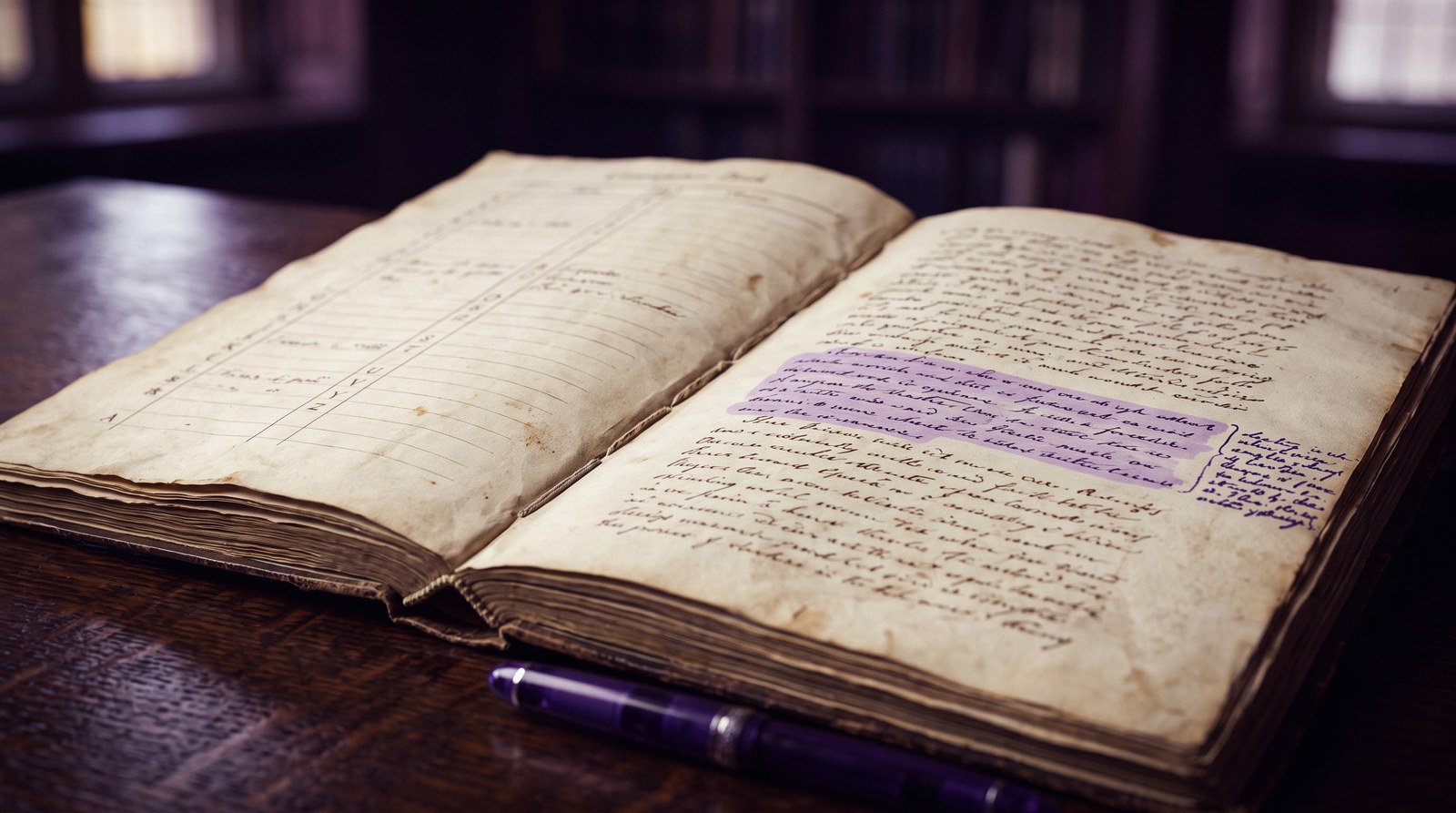
The British Library holds a notebook catalogued as Add MS 36354. It belonged to John Milton. He opened it in the 1630s and filled it over the best part of twenty years. Inside are quotes from more than ninety authors and notes on kingship, tyranny, marriage and divorce.
That notebook has a name. A commonplace book.
What is a commonplace book?
A commonplace book is a personal notebook where the quotes, ideas and observations you pull from your reading are gathered in one place under subject headings. The name comes from the Latin "locus communis", meaning common place. What is common about it is that thoughts from different books meet under the same heading.
The key word in that definition is heading. A commonplace book collects quotes by subject, not in the order they arrived. Five passages on tyranny, read across five different books over ten years, sit together on the same page. That is where the value comes from. Not from the individual quotes but from what they say to each other once they are gathered.
How is it different from a reading journal?
A reading journal tracks books. A commonplace book tracks ideas. A reading journal records which book you finished and when, what you rated it, how it made you feel. Its axis is the book, and the entry closes when the book does.
A commonplace book turns on the subject instead. A quote carries the book it came from, but it is not confined to it. The book ends, the heading stays open. Five years later, when another book brings you back to the same subject, you return to the same page.
A journal looks back. A commonplace book accumulates.
Who kept commonplace books?
The habit spread in the Renaissance. Erasmus advised his students in the 16th century to gather what they read under subject headings, and the method became a technique taught in schools.
Milton's notebook is one of the best known examples of that tradition. John Locke published a method for indexing such notebooks in 1686, which we will come to shortly. Thomas Jefferson compiled one from the poetry and literature he read in his youth, now published in a Princeton edition. Virginia Woolf worked through her reading in notebooks she bound by hand.
The poet W. H. Auden published his own collection as a book in 1970, called "A Certain World". He arranged the quotes under alphabetical subject headings. Auden described the book as a sort of autobiography. The interesting part is that it contains almost none of his own sentences. He still said it was about him.
How did Locke's index actually work?
The problem Locke solved was this. You open subject headings in a notebook, but before long you cannot find which heading sits on which page. Alphabetical order does not help either, because you cannot know in advance how much room each letter will need.
His method appeared in French in the journal Bibliothèque universelle et historique in 1686, and an English translation was printed in 1706. It works like this.
You set aside two pages at the front for an index. For each letter you rule five lines, one for each vowel, a, e, i, o, u. So under B you have Ba, Be, Bi, Bo and Bu.
When you open a new subject you give it a heading. Say the heading is Memory. Its first letter is M, and the first vowel after it is e. You find the e line under M in the index and write there the page number where the subject begins. The heading itself goes in the margin of the first empty page of the notebook.
Months later you find another quote on the same subject. You check the index. M, e. The page number is waiting. You turn to that page and add the new quote below the old one.
The clever part is that the method never tries to keep the pages in alphabetical order. Pages fill in whatever order they fill, and the index finds them again. Locke had separated retrieval from physical arrangement. Today we call that indexing.
What goes in a commonplace book?
The contents vary from person to person, but four things are typical. Quotes pulled from books, with the source and page number. Your own observations and objections, noted in the margin while reading. Ideas taken from conversations, articles and what you listen to. And definitions, small lists, pieces of knowledge you want to return to.
What they share is that every entry carries its source and belongs to a heading. A quote without a source turns into an orphaned sentence years later. A quote without a heading simply cannot be found.
Paper or digital?
Each one gives you something real and takes something real away.
What paper gives you is slowness. Copying a quote by hand means reading the sentence a second time, and that alone helps it stay. A notebook has a physical memory too, and you remember that a passage sat low on a left-hand page. What paper takes away is access. Even Locke's index only works for the single notebook in your hands. There is no practical way to search ten notebooks filled over twenty years.
Digital gives you exactly that. Search stands in for the index Locke kept by hand, and it does the job for every heading and every word at once. What it takes away is that second reading during the copying.
Before you choose, ask yourself one question. Do you want to think while writing the notebook, or while coming back to it. We wrote about why forgetting happens so fast, and how capture answers it, in a separate piece.
How do you start today?
You do not need an elaborate system. Three rules survive from Locke's method.
Pick one place and put everything there. The moment you have two notebooks, three apps and four folders, the notebook stops working.
Give every entry a heading. Tag, subject, folder, whatever you call it. Save a quote without attaching it to a heading and you have added to a pile, not an archive.
Always write the source with it. Book, author, page. A quote left with the source to be added later usually stays incomplete.
Then come back once a month and look at your headings. Whichever heading is thickening is the thing you have quietly been thinking about.
Where does PALIMPS fit?
PALIMPS is a commonplace book kept with a camera. You photograph a page. AI reads the quote, the highlight and the handwritten margin note separately. The page is saved as a moment with a short summary and automatic tags. The tags stand in for Locke's headings, and the search box for his index.
The source comes along on its own, because a moment already belongs to a book. You browse book titles, authors, quotes and notes with a single search. You can export the whole notebook as a PDF whenever you like.
Which brings us back to what Auden said. A commonplace book describes you even when it holds almost none of your own sentences. What you find worth keeping says more about you than what you read.